Environmental Social Governance in Urban Planning (ESG in UP)
Topic outline
-

-
Come and join our ESG in UP microcredential course!
We are excited to introduce a brand-new micro-credential course: Environmental, Social, Governance in Urban Planning (ESG in UP) from the Kulliyyah of Architecture & Environmental Design. The course is a practical and forward-thinking course designed to explore how ESG integration in Urban Planning accelerates development into a more sustainable practice.
 Whether you are a planner, architect, developer, government officer, student, researcher, or private sector professional curious about the adoption of ESG in the context of the urban planning and development sector, this course is your gateway to understanding how innovative techniques and tools can revolutionise the way we accelerate sustainable urban development — especially in the Malaysian context
This module intends to increase learners’ knowledge of the application of the principles of Environmental, Social, and Governance (ESG) in urban planning. Participants will gain insights into how ESG considerations can lead to the creation of sustainable, equitable, and resilient urban environments. Through a combination of theoretical frameworks, practical strategies, and case studies, learners will be equipped to integrate ESG principles into their planning processes effectively. Environment, Social, Governance in Urban Planning (ESG in UP)
RM 1500.00 | Duration: 140 Student Learning Time (Self-paced)
Course Fee: Course Instructors:
Asst. Prof. Ts. Dr Irina Safitri Zen & Asst. Prof. TPr. Dr. Syafiee Shuid
Kulliyyah of Architecture & Environmental Design, IIUM Gombak What you’ll learn:
 The basic principles of Environmental, Social, and Governance and Urban Planning
- How to describe the development strategies to integrate ESG principles into urban planning to reduce carbon emissions, enhance biodiversity, and improve resource efficiency;
- Ways to evaluate, apply and prioritise urban development strategy to support business/ development planning.
 Who Can Enrol?
Open to professionals — from IIUM and the public. No prior background in ESG and Urban Planning required! Certificate: An official e-certificate will be awarded upon successful completion of all modules and assessments.
To enrol in the course and access the learning materials, simply click on the link below or scan the QR code in the poster and log in with your IIUM email account:
Enrol Now:
https://microcredential.iium.edu.my/course/edit.php?id=81
Join us on this educational journey and unlock new opportunities for professional growth and development.
Your participation and support are highly appreciated.Program Synopsis
- This module intends to increase learners’ knowledge of the application of the principles of Environmental, Social, and Governance (ESG) in urban planning.
- Participants will gain insights into how ESG considerations can lead to the creation of sustainable, equitable, and resilient urban environments.
- Through a combination of theoretical frameworks, practical strategies, and case studies, learners will be equipped to integrate ESG principles into their planning processes effectively.
-
The course addresses the critical role cities play in the global climate crisis, noting that cities consume 78% of global energy and produce over 70% of greenhouse gas emissions. By 2050, 68% of the world's population is expected to live in urban areas, making ESG integration essential to avoid climate catastrophe, social inequality, and governance failures. ESG principles provide the framework to create cities that are low-carbon, inclusive, resilient, and economically viable.
Learning Outcomes:Participants will develop three core competencies:
i. ESG Understanding: Comprehensive knowledge of ESG principles, their application to sustainable urban planning, and Islamic urbanism principles.
ii. Practical Strategy Integration: Strategies to reduce carbon emissions through transit-oriented development, enhance biodiversity via green corridors, and improve resource efficiency through circular economy approaches.
iii. Strategic Alignment: Development of strategies that support business viability, attract green investments, and align with national development agendas like Malaysia Madani.
Course Components
The program includes four core modules covering
i. ESG fundamentals, dimensions, and practical tools.
ii. ESG checklists and compliance frameworks.
iii. Investment attraction strategies
iv. Real-world case studies from Malaysian cities and urban planning traditions.
-
This video explains how corporate ESG standards are currently reshaping modern city planning and development.
The video "The Two Faces of Green Urbanism" explores how corporate Environmental, Social, and Governance (ESG) standards are fundamentally reshaping modern city planning. It highlights the dual nature of this transformation: while ESG drives critical climate resilience and investment, it simultaneously risks deepening urban inequality.
-
-
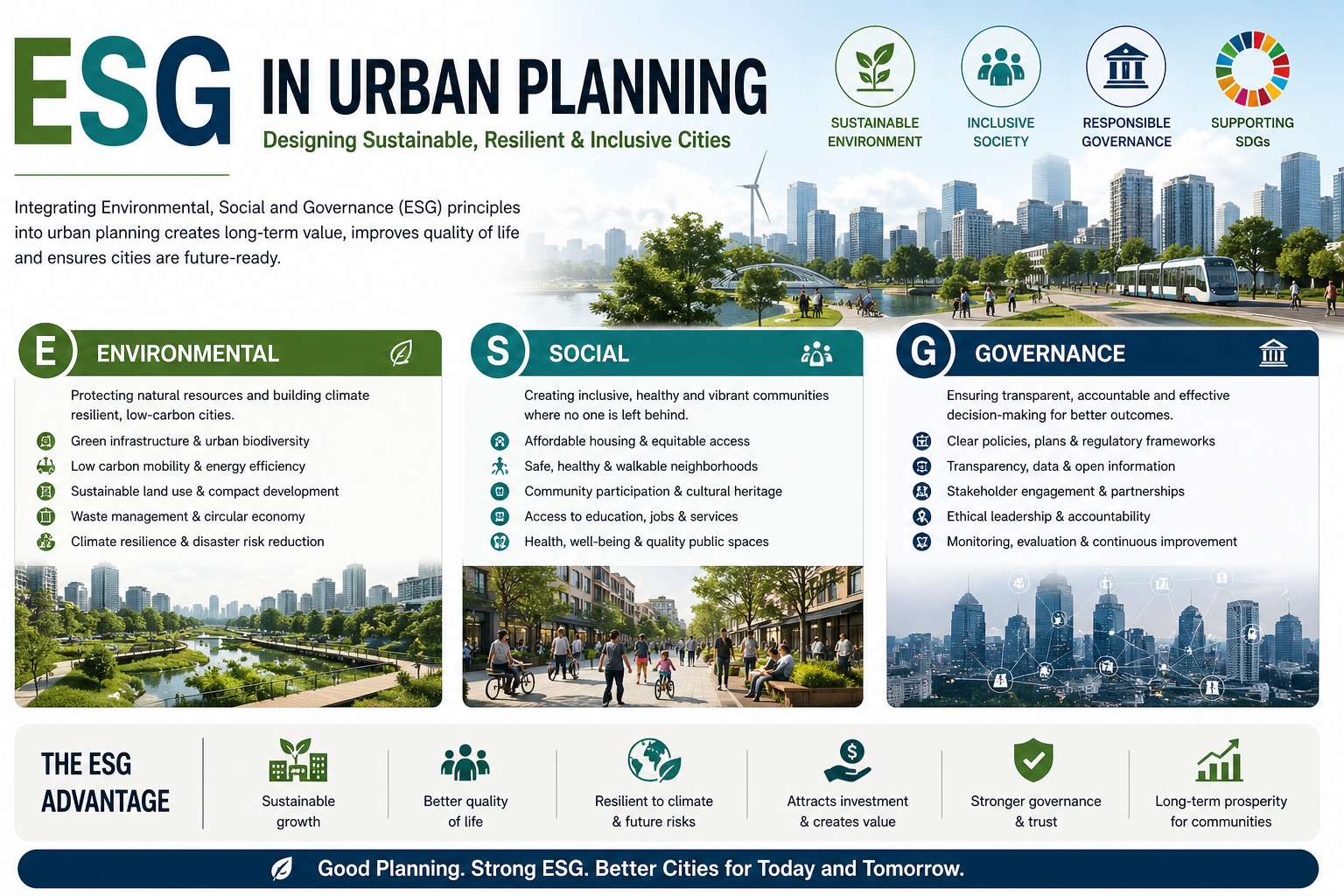
The course provides material that introduces a training program focused on integrating Environmental, Social, and Governance (ESG) principles into urban planning to foster sustainable development. It details four specific learning modules that cover foundational concepts, ecological protection, social equity, and regulatory frameworks.
The content emphasises how global standards, such as the United Nations Sustainable Development Goals and GRI reporting, act as essential tools for creating resilient cities. Furthermore, the sources highlight Malaysia’s national policies as practical examples of aligning local development with international sustainability mandates. Ultimately, the text defines ESG as the data-driven mechanism used to measure and achieve the broader objectives of long-term environmental stewardship and ethical leadership.
-
- These educational materials from the Kulliyyah of Architecture & Environmental Design provide a detailed framework for integrating Environmental, Social, and Governance (ESG) principles into urban planning.
- The curriculum is structured into four modules that transition from foundational ESG concepts and global reporting standards to practical applications within the Malaysian context.
- Key objectives include improving climate resilience, fostering social equity, and establishing transparent governance to attract green investment and support national development goals.
- The sources also distinguish between corporate ESG and urban planning ESG, noting that city-scale assessments focus on broader community impacts such as biodiversity, affordable housing, and public transport accessibility.
- By employing materiality assessments and specific performance indicators, the modules guide planners through a continuous cycle of sustainable development and ethical decision-making. These documents serve as a comprehensive roadmap for transforming cities into resilient, inclusive, and environmentally responsible urban environments.
-
-
-
The provided video explores the environmental dimension of Environmental, Social, and Governance (ESG) criteria within the context of urban planning. The following summary outlines the key topics discussed:
The Environmental Pillar in Urban Planning
The environmental dimension of ESG focuses on protecting ecosystems, reducing emissions, and building climate resilience. Key areas of concern include carbon emissions, air and water quality, waste management, biodiversity, and resource efficiency. By embedding these ESG dimensions into urban planning, cities can shift from being contributors to environmental problems to becoming active participants in global sustainability.Critical Environmental Challenges
Emissions and Pollution: Cities are major consumers of energy and sources of emissions, particularly through transportation, buildings, and industry. Poor planning can lock cities into car-dependent layouts and inefficient infrastructure. Water and Waste: Many cities grapple with flooding, water scarcity, and overwhelmed waste systems due to factors like impermeable surfaces and rapid urbanisation.Sustainable Resource Management:
Urban planning can promote sustainability through: Compact, mixed-use developments that reduce land consumption and travel needs.
Energy-efficient buildings and the integration of renewable energy.
Water-sensitive designs such as rainwater harvesting and constructed wetlands.
Adopting circular economy principles, including recycling hubs and reusing existing infrastructure rather than constant expansion.
ESG requires planners to quantify resource management using measurable indicators such as per-capita energy intensity and waste diversion.
Climate Change and Resilience Strategies
Mitigation: Strategies include supporting low-carbon mobility (e.g., public transport, electric vehicles) and protecting carbon-sequestering ecosystems like urban forests.
Adaptation: Planning should incorporate climate risk mapping, hazard-based zoning to avoid high-risk areas, and nature-based solutions like green roofs and restored river corridors.Infrastructure: Resilience is strengthened through robust designs such as flood-resilient drainage and diversified water sources.
Enhancing Sustainable Urban Planning with ESG-Measurable Performance: ESG moves planning beyond optional "green" add-ons by requiring explicit targets for emissions and biodiversity, thereby making performance accountable.
Investment and Governance: ESG frameworks help cities attract green financing and encourage integrated, transparent decision-making across various municipal departments. Long-Term Vision: By assessing life-cycle emissions and climate risks, ESG helps prevent cities from being locked into high-carbon, resource-intensive forms.
-
-
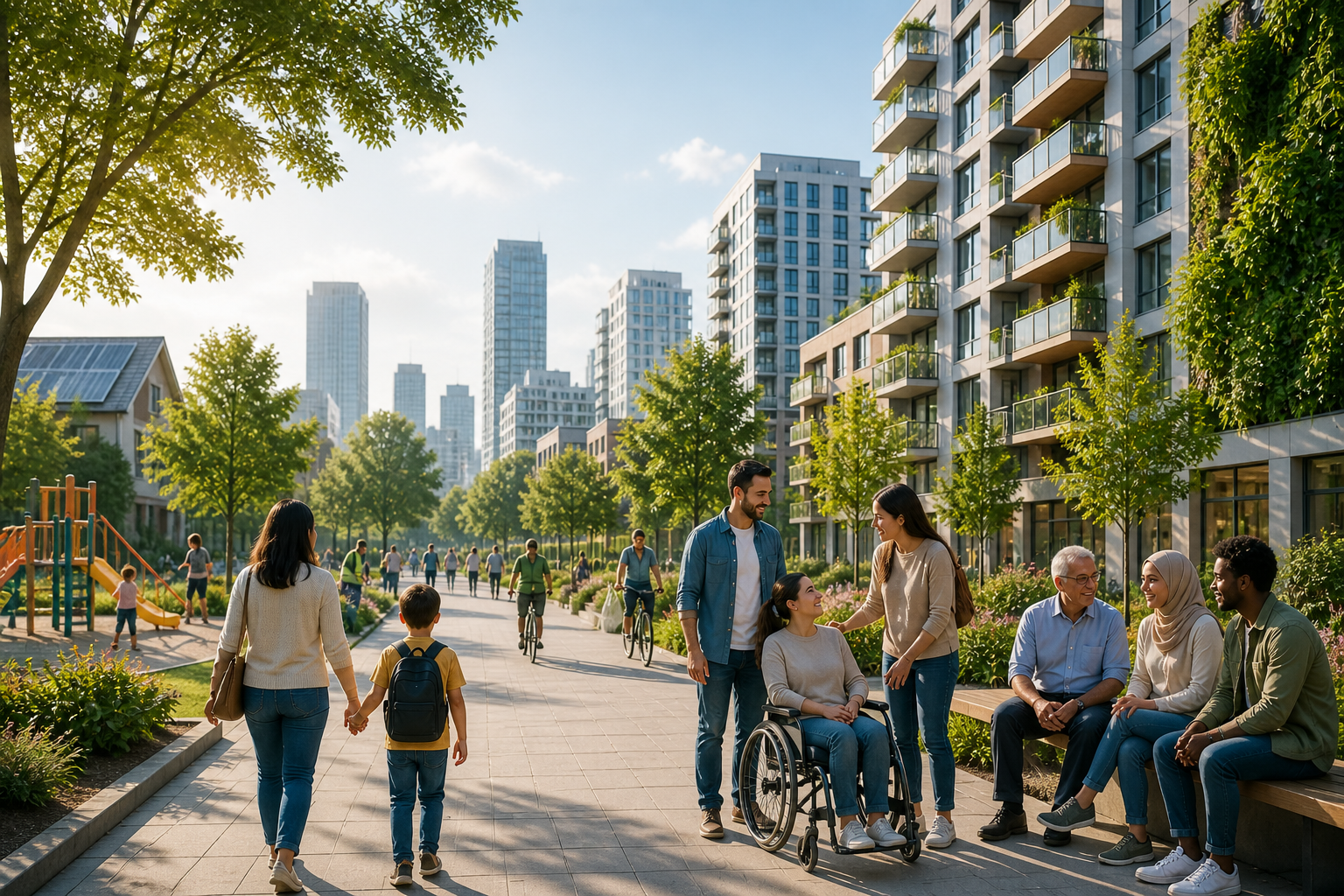
The social (S) pillar of ESG within urban planning focuses on how development can promote equity, inclusion, and community well-being alongside environmental objectives.
The key themes and topics are summarised below:
The Social Dimension of ESG in Cities
Current Urban Challenges
Inclusivity and Accessibility Strategies
Engagement and Accountability
Holistic Sustainability
-
-
-
Urban Rejuvenation or Social Displacement?
Evaluating the ESG Performance of Kampung Harmoni Redevelopment
Brief Introduction
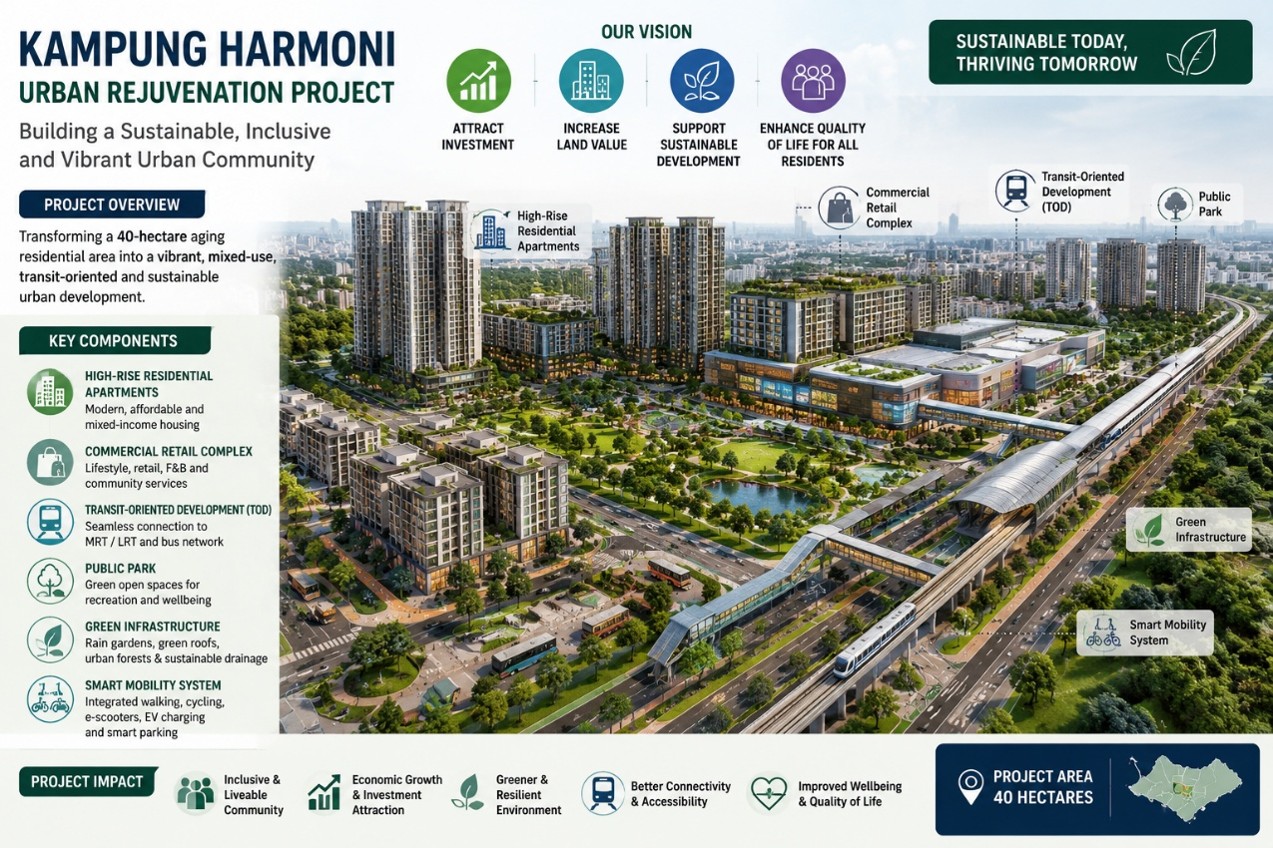
The Kampung Harmoni Urban Rejuvenation Project demonstrates the Social (S) pillar of ESG by prioritising people-centred urban development that enhances inclusivity, accessibility, and quality of life. The proposed mixed-use, transit-oriented neighbourhood integrates affordable housing, public parks, commercial facilities, and sustainable mobility options to create a vibrant and connected community. By providing seamless access to public transport, green open spaces, and essential services, the project encourages social interaction, healthy lifestyles, and equitable access to opportunities for residents of different ages and income groups.
From an ESG perspective, the development promotes social equity through mixed-income residential housing, community wellbeing through recreational parks and green infrastructure, and universal accessibility by integrating pedestrian-friendly streets, cycling networks, and public transportation. The inclusion of retail, employment opportunities, and community amenities within walking distance supports a live-work-play environment that reduces social exclusion while strengthening community resilience. Overall, the project reflects how urban planning can create an inclusive, safe, and sustainable city that improves the wellbeing of current and future generations. -
Background
The City Council has approved the Kampung Harmoni Urban Rejuvenation Project, transforming a 40-hectare ageing residential area into a mixed-use development.
The proposed project includes:- High-rise residential apartments
- Commercial retail complex
- Transit-oriented development (TOD)
- Public park
- Green infrastructure
- Smart mobility system
However, concerns have emerged from local communities regarding:- Rising housing prices
- Potential displacement of low-income households
- Loss of community identity
- Accessibility for elderly and disabled residents
- Reduction of affordable public spaces
Existing Site ConditionsIndicator
Existing Situation
Population
5,200 residents
Low-income households (B40)
68%
Elderly (>65 years)
18%
Children (<15 years)
24%
Persons with Disabilities (PWD)
4%
Affordable housing
82%
Public transport
One bus route
Public park
Small neighbourhood park
Walking distance to clinic
1.8 km
Walking distance to fresh market
2.2 km
Proposed DevelopmentComponent
Proposal
Luxury apartments
2,500 units
Affordable housing
300 units
Shopping mall
Yes
TOD station
Yes
Green park
12 hectares
Community centre
Removed
Hawker centre
Relocated
Existing residents relocated
1,900 households
Community Feedback (SIA Survey)
Residents identified the following concerns:Issue
Percentage of respondents
Fear of displacement
82%
Housing affordability
77%
Loss of social network
69%
Insufficient affordable housing
75%
Lack of child-friendly spaces
48%
Poor elderly accessibility
53%
Increased living cost
81%
Scenario
You have been appointed by the Local Authority as an Urban ESG Consultant to evaluate the proposed Kampung Harmoni Urban Rejuvenation Project.
The redevelopment includes:- High-rise residential apartments
- Commercial retail complex
- Transit-Oriented Development (TOD)
- Public park
- Green infrastructure
- Smart mobility system
Evaluate the project from the perspective of the Social (S) Pillar of ESG.
-
-
The key concepts regarding the governance dimension of ESG in urban planning, as presented in the video:
Defining Governance in ESG: Governance serves as the foundation for organizational integrity, encompassing the structures, policies, and processes that facilitate ethical leadership, accountability, and risk management. It functions as the "rules of the game" by guiding how decisions are made, reported, and overseen to protect stakeholders and ensure long-term value.
Core Governance Criteria:
Key areas include: Board Composition: Focusing on diversity, independence, and aligning compensation with sustainable performance. Ethics and Compliance: Implementing anti-corruption measures, whistleblower protections, and conduct codes.Risk Management and Reporting: Conducting audits, upholding shareholder rights, and providing transparent disclosures regarding issues like data privacy. Application in Urban Planning: Strong ESG governance integrates transparency into zoning, procurement, and public engagement to prevent inequity and ensure accountability. Methods include establishing multi-level structures, independent oversight boards, citizen audits, and digital dashboards to align development with goals such as the UN Sustainable Development Goals.
Real-World Examples:
Singapore: Utilizes an independent urban redevelopment authority that enforces ESG-aligned zoning with public transparency tools. Copenhagen: Employs citizen oversight committees to audit green projects, enhancing trust and efficiency.
Kuala Lumpur: Uses open data portals for planning approvals to blend heritage preservation with accountability. Challenges and Integration: Rapid urbanization, weak enforcement, inter-agency silos, and profit pressures remain significant challenges. To address these, urban planners are encouraged to establish independent project review boards, mandate ESG audits in procurement and zoning, and launch stakeholder portals for real-time feedback. -
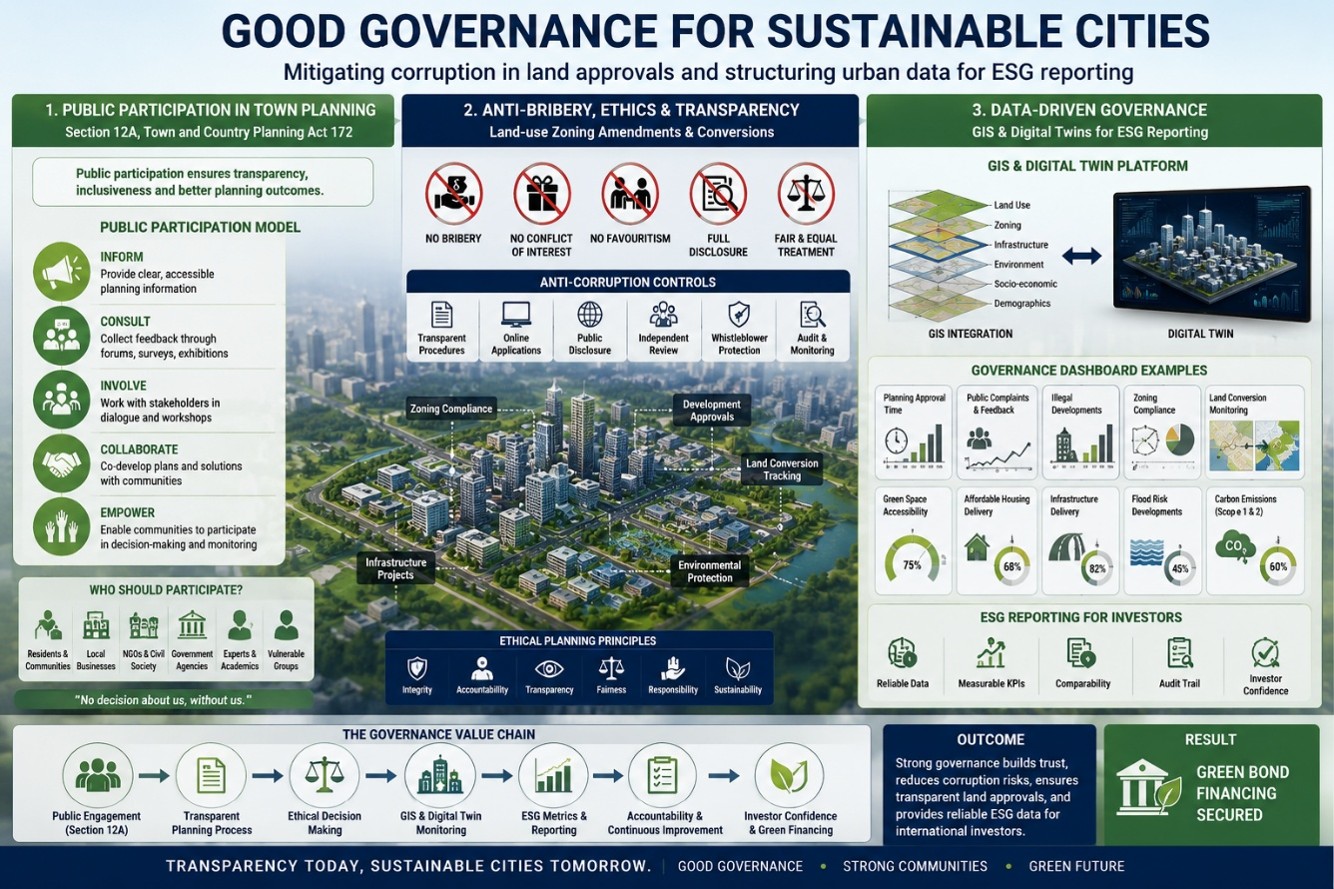
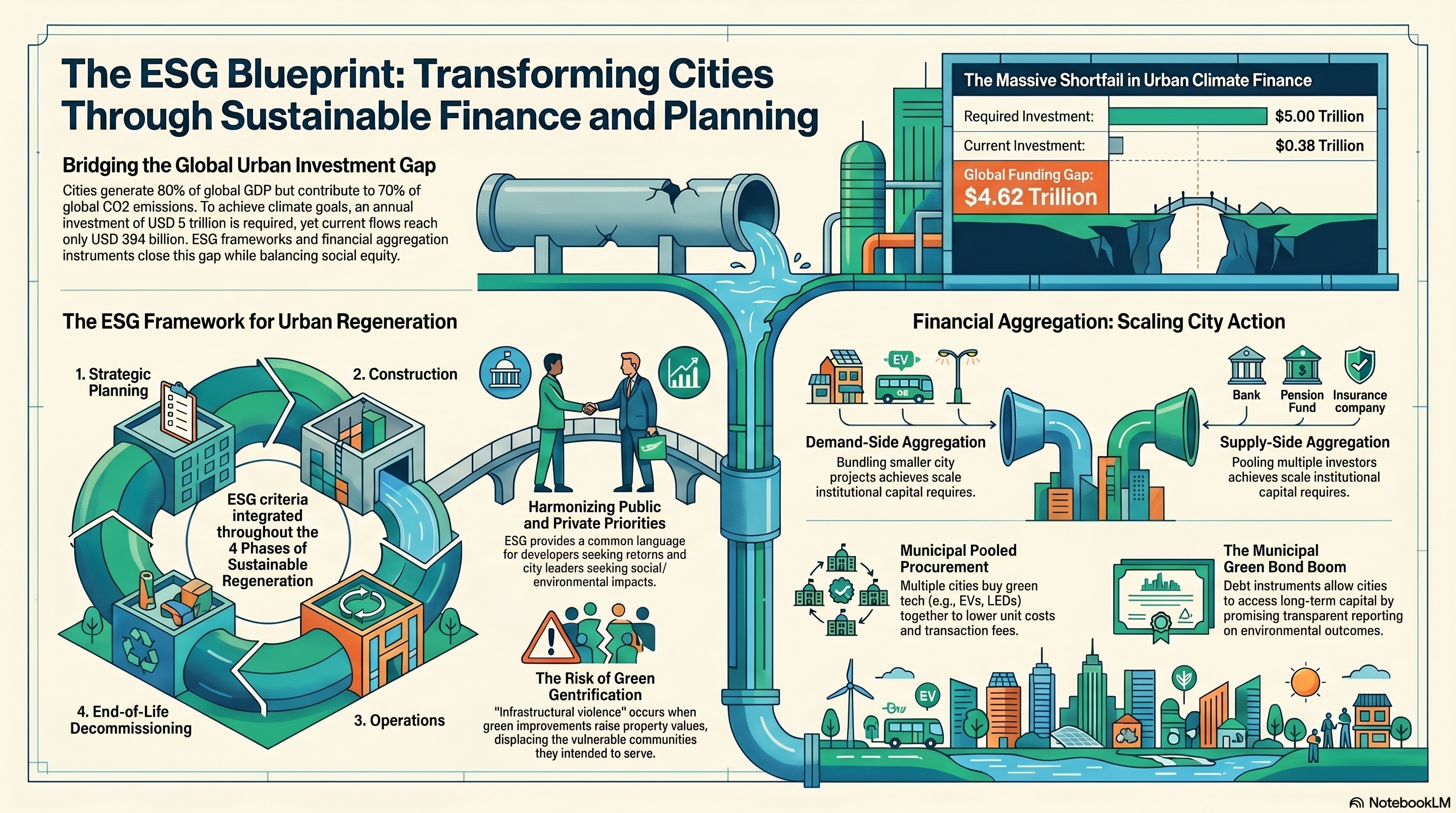
Brief Description
This infographic illustrates how good governance supports sustainable urban development by integrating transparency, ethical decision-making, and digital innovation into town planning. It highlights three key pillars: public participation, anti-bribery and transparency, and data-driven governance through Geographic Information Systems (GIS) and digital twin technology.Together, these approaches promote accountable land-use planning, reduce corruption risks, improve monitoring of development activities, and strengthen ESG (Environmental, Social, and Governance) reporting. The governance value chain demonstrates how inclusive planning, transparent procedures, ethical practices, and reliable urban data can build investor confidence, enhance public trust, and support sustainable city development and green financing.
Comprehensive Scenario-Based Examination
Theme: Securing International Green Bond Financing through ESG-Compliant Urban Governance
Duration: 90 Minutes
Total Marks: 100
Assessment Type: Planning Board Simulation (Scenario-Based)
Scenario
You are an Urban ESG Planning Consultant appointed by the Local Authority to present the proposed Green Horizon Smart City Redevelopment Project to an international panel of green bond investors.
The municipality intends to obtain USD 500 million in Green Bond financing to fund:- Mixed-use transit-oriented development (TOD)
- Affordable housing
- Green public infrastructure
- Climate-resilient drainage
- Urban biodiversity corridors
- Digital twin platform
- Smart mobility system
- Net-zero municipal buildings
- ESG Principles
- GRI Standards
- ICMA Green Bond Principles
- SDGs
- Malaysia's Town and Country Planning Act 1976 (Act 172)
- Anti-Bribery Management System (ISO 37001)
- Good Urban Governance
-
-
-
Concluding session for a microcredential course on ESG in urban planning, reflecting on the participants' achievements and the future application of their new skills.
The three core competencies mastered during the course:
i. Comprehensive ESG Understanding: Participants gained knowledge on how environmental stewardship, social equity, and governance integrity support sustainable urbanism, aligning these concepts with Islamic principles of amanah (trust) and justice.ii. Practical Integration Strategies: Participants acquired actionable tools to embed ESG into urban planning, including techniques for creating compact, low-carbon urban forms that reduce emissions by 30% to 50%, enhancing biodiversity through green corridors, and implementing circular resource systems that achieve 40% efficiency gains.
iii. Business-Aligned Development: Graduates are now capable of championing ESG-compliant master plans that attract green sukuk investment and Malaysia Madani funding while fostering community prosperity.
By 2050, when 68% of humanity is expected to live in urban areas, ESG-integrated planning will be essential to create environmentally regenerative, net-zero, and socially inclusive cities with transparent governance.
The certification equips participants with a toolkit tailored to the Malaysian context, positioning them for various roles, including:
- Urban planners and ESG compliance experts.
- Leaders in green building certification and Islamic urban design.
- Green financing specialists and policymakers who align local plans with national sustainability goals.
-
Case Study Assignment: Integrating ESG Principles into Urban Planning (Malaysia Focus)
Course Context- Institution: Kulliyyah of Architecture & Environmental Design, International Islamic University Malaysia (IIUM)
- Topic: Environmental, Social, and Governance (ESG) in Urban Planning (UP)
- Target Learning Outcomes:
- MLO1: Demonstrate a comprehensive understanding of ESG principles and their direct application to sustainable urban planning practices.
- MLO2: Develop practical strategies to integrate ESG into urban planning processes, specifically targeting carbon reduction (TOD), urban biodiversity enhancement (green corridors/nature-based solutions), and resource efficiency (circular economy).
- MLO3: Prioritise urban development strategies that support business viability, attract green investment, and align with national agendas like Malaysia MADANI.
Background & Scenario
You are a senior urban planner and ESG consultant advising a Local Authority (Pihak Berkuasa Tempatan - PBT) and a private property developer in Malaysia.
The local council is launching a new brownfield redevelopment project under the Urban Redevelopment Act (URRA) and the Bandar MADANI Framework, aligned with the 13th Malaysia Plan (13MP, 2026–2030). The initiative aims to transition an ageing urban township into a smart, transit-oriented, low-carbon hub. To fund the development, the project needs to qualify for green financing mechanisms (e.g., Green Bonds, MIDA DIAF-ESG Grants, or EDGE Zero Carbon certification) by scoring high on the ESG Investment-Ready Index.
Assignment Tasks
Task 1: Environmental Strategy & Technical Measures (MLO1 & MLO2)- Low-Carbon & TOD Integration: Propose three concrete land-use and transportation strategies using Transit-Oriented Development (TOD) to assist Malaysia in meeting its target of a 45% reduction in carbon intensity by 2030 under the National Climate Change Policy 2.0.
- Circular Waste & Natural Capital: Outline a sustainable waste and water management framework for the development.
- Detail how waste concessionaires (e.g., Alam Flora) can incorporate e-waste drop-offs, smart IoT waste bins, and low-carbon fleet routing.
- Describe how nature-based solutions (e.g., flood mitigation, river rehabilitation, or wetlands) can be designed to enhance natural capital and climate resilience.
- Stakeholder Alignment: Identify key affected stakeholders (local communities, businesses, local government, investors, workers). Explain how multi-stakeholder participation during the planning approval stage helps mitigate reputational and regulatory risks.
- Community Impact: Formulate two social initiatives that elevate worker welfare/safety during construction and improve long-term public access to essential healthcare, green spaces, or digital services.
- National Policy Alignment: Explain how your proposed urban plan directly incorporates the Bandar MADANI concept and supports the 13th Malaysia Plan (13MP) goals of "Reshaping Development" through sustainability and digital transformation.
- Green Financing & Transparency: Detail how compliance with the National Sustainability Reporting Framework (NSRF) and transparent municipal ESG disclosures can assist the project in securing green bonds or private ESG-driven investments.
- Overcoming Implementation Gaps: Analyze two major challenges faced by local authorities in Malaysia (e.g., data fragmentation, capacity constraints, or uneven execution across municipalities) and recommend actionable solutions.
Submission Deliverables & Format- Format: Written Report (PDF) / Executive Presentation Slide Deck.
- Length: 2,000–2,500 words or 12–15 slide presentation pitch.
- Assessment Criteria: Clarity of ESG concept integration (30%), practicality of urban planning strategies (30%), depth of alignment with Malaysian national policies/frameworks (20%), and critical analysis of governance/challenges (20%).
-